
The 7-Day Zanzibar Itinerary: The Health-Smart Version

A health-smart 7-day Zanzibar trip runs Stone Town's old city to Prison Island's giant tortoises to the north-coast beaches of Nungwi, with a day trip into Jozani Forest for the archipelago's endemic red colobus monkey. The single factor that should shape your plan is malaria: CDC lists year-round chloroquine-resistant risk across Zanzibar, and a November 2023 to March 2024 epidemic logged more than 23,500 confirmed cases on islands many travelers had assumed were low-risk, per a peer-reviewed spatiotemporal analysis. Atovaquone-proguanil is a CDC first-line option with the shortest pre-trip and post-trip dosing window of any malaria pill on the market. Traveler's diarrhea and equatorial heat are secondary concerns on this route. Speak with a provider about your dates and health history.
Zanzibar has spent years marketed as a beach postscript to a Tanzanian safari, the kind of place you unwind after Serengeti dust with little more to plan than sunscreen. The health reality is more specific than that. This is a malaria-endemic archipelago that just came off its largest outbreak in a decade, and the trip that respects that fact, rather than assuming the ocean air keeps it away, is barely different from the one every guidebook already recommends. This itinerary keeps the classic Stone Town-to-Nungwi route and builds the antimalarial timing, bite discipline, and travel-medicine kit around it, so the history, the tortoises, and the beach days stay the story instead of a lost day to illness.
Who this itinerary is for
This is a comfortable first Zanzibar trip for travelers who want culture, wildlife, and real beach time without a demanding pace. Two nights in Stone Town cover the history and the spice-farm morning, three nights in Nungwi are built for swimming and slower days, and the Jozani Forest and Prison Island add-ons are half-day and day-trip length rather than expedition-scale. Nothing here requires trekking fitness or altitude acclimatization; the planning load sits almost entirely in the malaria-prevention timeline, not the itinerary itself, which makes this a manageable route for families, couples, and solo travelers alike.
It also suits returning travelers, including anyone who has been to Zanzibar before and assumed the malaria conversation was settled by the island's near-elimination years. The 2023-24 epidemic changed that calculus for the whole archipelago, Stone Town and Nungwi included, and the adjustments here (when to start your antimalarial, how to handle dusk boat rides and forest walks) are aimed at exactly that gap between old assumptions and current risk.
One honest note on scope. This route stays on Unguja, the main island, with Pemba treated as an optional single-day add-on rather than a full leg of the trip. Divers who want real time on Pemba's coral walls, or travelers hoping to combine Zanzibar with a mainland safari, will want to extend past 7 days. As written, this itinerary is built to do Stone Town and the north coast well in a single focused week, not to cover the entire archipelago.
The route
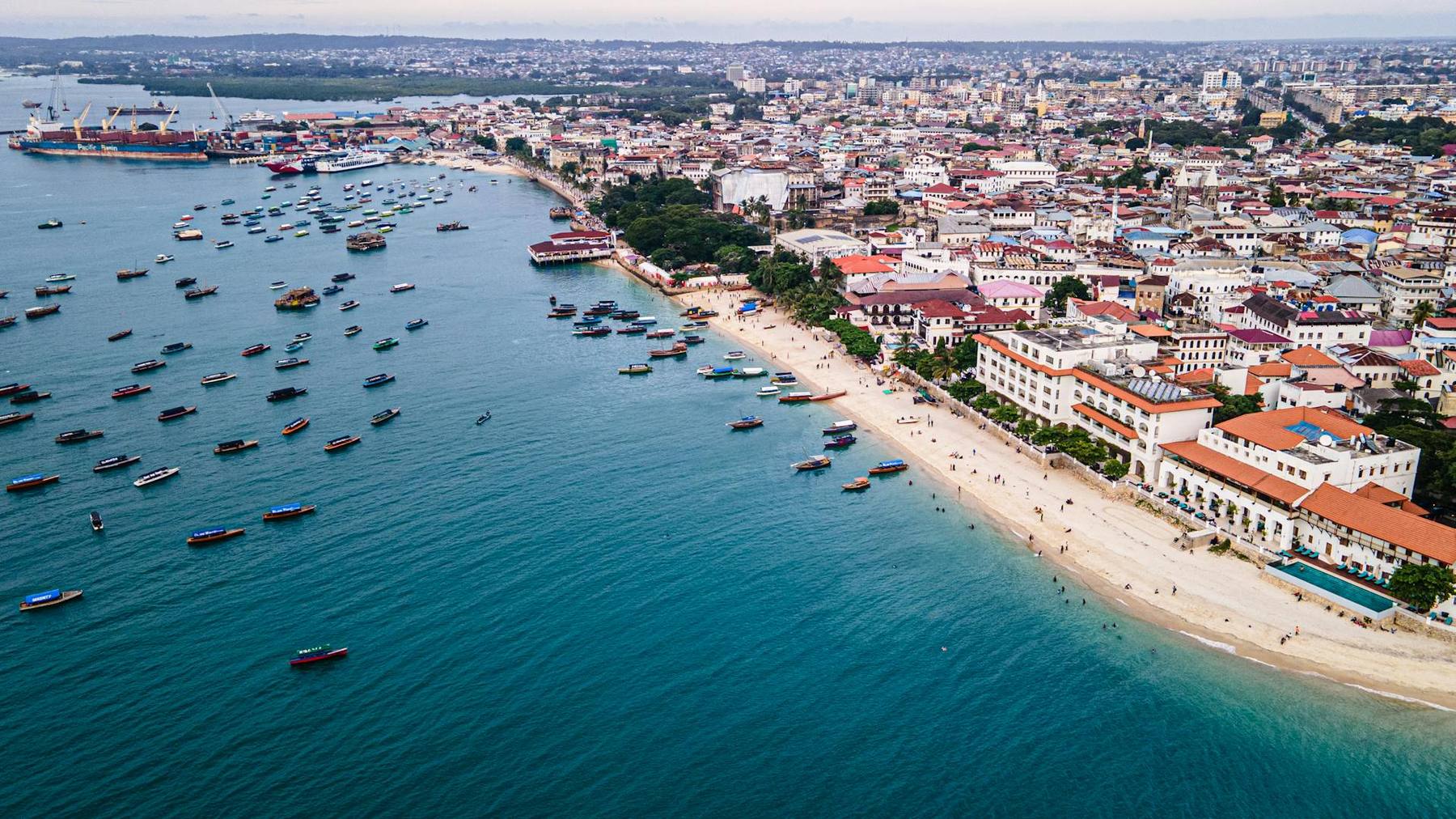
The week runs south to north across Unguja, Zanzibar's main island, with two easy side trips. You start in Stone Town, the UNESCO-listed old quarter on the west coast, for two nights of history, markets, and a spice-farm visit. From Stone Town, a short boat crossing reaches Prison Island (Changuu) for the giant tortoises and easy snorkeling before you continue north.
The drive from Stone Town to Nungwi, at the island's northern tip, takes roughly 1.5 to 2 hours and trades the old city's narrow lanes for open beach and turquoise water. Nungwi is your base for three nights, long enough for a genuine beach reset plus one substantial day trip: south to Jozani Chwaka Bay National Park for the red colobus monkeys, or, for divers, a same-day flight out to Pemba for its coral walls. The loop closes back through Stone Town for departure, so you see both faces of the archipelago, old city and open coast, without doubling back more than once.
This south-to-north, then back-south structure also happens to line up with how the health planning works best. You front-load the historic, walkable days in Stone Town while your antimalarial course is just getting started, then spend the back half of the trip on the beach once the daily routine, repellent at dusk, sunscreen through the afternoon, medication with dinner, has become automatic.

Day-by-day plan
Day 1: Arrive Zanzibar, settle into Stone Town
Land at Abeid Amani Karume International Airport (ZNZ) and transfer about 20 minutes into Stone Town. Anopheles mosquitoes, the species that transmits malaria, bite from dusk through dawn, so start your bite-avoidance habits tonight: repellent, long sleeves in the evening, and a screened or air-conditioned room, even before your antimalarial course begins in earnest. Keep the first evening light, a walk along the waterfront and an early dinner is plenty after a long flight.
Day 2: Stone Town history and a spice-farm morning
Spend the day in the old city: the House of Wonders, the Old Fort, and the Old Slave Market memorial, a sober but essential stop given Stone Town's history as a hub of the East African slave trade. Add a morning spice-farm visit just outside town, a nod to the centuries Zanzibar spent as the world's dominant clove exporter. The alleys are shaded but the humidity sits high, so carry sealed water throughout and favor food that's cooked hot and served immediately.
Day 3: Prison Island tortoises, transfer to Nungwi
A short boat ride reaches Prison Island (Changuu), home to giant Aldabra tortoises, some documented at well over a century old, and a reef good for an easy snorkel. From there, transfer north to Nungwi, roughly 1.5 to 2 hours by road. Reapply reef-safe, non-nano mineral sunscreen after every swim; the equatorial sun burns faster than the breeze off the water lets on, and standard sunscreens can damage the coral you're swimming over.
Day 4: Nungwi beach day
A full day on Nungwi's white sand, with an optional dhow sailboat trip along the north coast for sunset. Take your atovaquone-proguanil with food at the same time each day, ideally dinner, and keep it up even on a relaxed beach day, consistency matters more than any single dose. If your dhow trip runs into dusk, that's also when Anopheles mosquitoes become active, so keep repellent on for the ride back.
Want the health prep for Tanzania?
Get a 60-second pre-trip check: the vaccines, prescriptions, and altitude/seasonality notes that change the plan — built for your exact dates.
Day 5: Jozani Forest and the red colobus monkeys
A day trip south to Jozani Chwaka Bay National Park, Zanzibar's only national park and the primary home of the Zanzibar red colobus monkey, an endangered species found nowhere else on Earth. A boardwalk through the adjoining mangrove forest rounds out the visit, a good contrast to the beach days on either side of it. The forest is humid and buggy even by daylight, so keep repellent on, wear closed shoes on the boardwalk, and carry water for the roughly 1.5 to 2 hour drive each way from Nungwi.

Day 6: Free beach day, or a Pemba day trip
Keep it flexible. Most travelers spend the day relaxing at Nungwi or nearby Kendwa, but divers can fly to Pemba, roughly 30 minutes each way, for a day on its steep coral walls, widely considered some of the best diving in East Africa. If you dive, respect standard no-fly guidance, typically at least 12 to 24 hours between your last dive and any flight, before the short hop back to Unguja. Non-divers can use the same day for a slower beach morning and an afternoon market stop back toward Stone Town.
Day 7: Return to Stone Town, depart
Transfer back to Stone Town for a last walk or market stop, then on to the airport. Keep taking your atovaquone-proguanil daily through today, and continue it for a full 7 days after you leave Tanzania, the short post-trip window that makes it the least disruptive of the CDC-recommended options once you're home and back to your normal routine.
Health prep for this trip
The single decision that shapes this trip is when you start your malaria prevention. Atovaquone-proguanil needs only 1 to 2 days of lead time before you enter a malaria area and 7 days of follow-through after you leave, the shortest pre- and post-trip window of any CDC-recommended option, which is why it suits a focused week-long beach trip better than a med with a longer wind-down. Book your malaria-prevention visit through the Zanzibar Beach & Stone Town travel plan, which pairs atovaquone-proguanil for malaria with prescription-strength ibuprofen for heat headaches and dive or dhow-day soreness, and clotrimazole-betamethasone for the humid, wet-swimwear skin irritation that comes with a week of beaches and boats.
Beyond malaria, the CDC also recommends routine vaccines plus hepatitis A and typhoid for most travelers to Tanzania, worth confirming with a travel provider several weeks out rather than the week you fly. Traveler's diarrhea is handled here through food and water discipline rather than a standing antibiotic: sealed water, hot cooked food, caution with ice outside established hotels, and hand hygiene before meals. Pack oral rehydration salts as a low-cost backup for the first sign of loose stools, and treat persistent fever, bloody stools, or symptoms that don't improve within a day or two as a reason to see a local provider rather than wait it out. Read the Tanzania destination guide for the country-level picture before you build out the rest of your kit.
What to pack
Lightweight, breathable clothing and a wide-brim hat for Stone Town's shaded but humid streets. A dusk-to-dawn insect repellent (DEET or picaridin) for Anopheles protection, applied daily regardless of how far you are from standing water. A reef-safe, non-nano mineral sunscreen for the Prison Island and Nungwi swimming and snorkeling days, both for your skin and the reef itself. Closed shoes for the Jozani Forest boardwalk, modest clothing for Stone Town's markets and mosques out of cultural respect, and a light rain layer if you're traveling anywhere near the shoulder seasons. Bring more sunscreen and repellent than you think you need; both are harder to find in the specific formulations you'd want once you're on the islands.
Best time to go and what to avoid
Season | Months | Notes |
|---|---|---|
Long dry season | June-October | Most reliable weather; generally the best window for beach days and diving visibility |
Long rains | March-May | Heavy afternoon downpours, high humidity; malaria risk continues regardless |
Short rains | November-December | Lighter, less predictable showers than the long rains |
Malaria risk itself does not track the seasons the way it does in some countries; CDC lists it as present year-round across the archipelago, so the prevention plan stays the same whichever window you travel in. Weather mainly affects comfort, road conditions on the Stone Town-to-Nungwi drive, and diving visibility around Pemba, not whether you need an antimalarial. If your dates fall in the long rains, build a little slack into the Jozani Forest day in particular, the boardwalk and access roads are the first to be affected by heavy downpours.
Cost expectations
A week split between Stone Town and Nungwi runs from budget guesthouses to high-end beach resorts, with Nungwi generally pricier per night than Stone Town given its beachfront demand. Add day-trip costs for Prison Island, the spice farm, and Jozani Forest park entry, plus, if you add Pemba, the short domestic flight and any dive-operator fees on top of your accommodation. This is not a budget-backpacker archipelago on the north coast, but it is well below the cost of an equivalent East African safari, and travelers who mix a few Stone Town guesthouse nights with a mid-range Nungwi resort stretch their budget furthest.
Day-by-day plan
| Day | What you're doing | Health note |
|---|---|---|
| 1 | Arrive Zanzibar, settle into Stone Town Land at Abeid Amani Karume International Airport (ZNZ) and transfer about 20 minutes into Stone Town for two nights. | Anopheles mosquitoes bite from dusk through dawn, so start using repellent and sleeping under a net or in a screened, air-conditioned room from your first night, even before you begin your malaria pill. |
| 2 | Stone Town history and a spice-farm morning Walk the House of Wonders, the Old Fort, and the Old Slave Market memorial, then spend the morning at a nearby spice farm outside town. | Stone Town's alleys are shaded but the humidity is real. Carry sealed water, and favor food that is cooked hot and served immediately over anything that has been sitting out. |
| 3 | Prison Island tortoises, transfer to Nungwi A short boat out to Prison Island (Changuu) for the giant Aldabra tortoises and reef snorkeling, then a roughly 1.5 to 2 hour drive north to Nungwi. | Reef-safe, non-nano mineral sunscreen protects both your skin and the coral you'll be swimming over. Reapply after every swim, the equatorial sun burns faster than it feels. |
| 4 | Nungwi beach day A full day on Nungwi's white-sand beach, with the option of a dhow sailboat trip along the north coast. | Take your daily atovaquone-proguanil with food at the same time each day. If you are on a boat at dusk, this is also when Anopheles mosquitoes become active, so keep repellent on for the ride back. |
| 5 | Jozani Forest and the red colobus monkeys A day trip south to Jozani Chwaka Bay National Park, Zanzibar's only national park, for the endemic Zanzibar red colobus monkey and a mangrove boardwalk. | The forest walk is humid and buggy even by day. Keep repellent on for the boardwalk, wear closed shoes, and carry water for the roughly 1.5 to 2 hour drive each way from Nungwi. |
| 6 | Free beach day, or a Pemba day trip A flexible day: relax at Nungwi or Kendwa, or take the roughly 30-minute flight to Pemba for a day of diving on its steep coral walls. | If you dive on Pemba, follow standard no-fly guidance (typically at least 12 to 24 hours between your last dive and any flight) before your short hop back to Unguja, to avoid decompression sickness. |
| 7 | Return to Stone Town, depart Transfer back to Stone Town for a final walk or market stop, then to the airport for your departure flight. | Keep taking atovaquone-proguanil daily through your last day here, and continue it for a full 7 days after you leave Tanzania, the dosing window that makes it the shortest-tail option among CDC-recommended malaria pills. |
Frequently Asked Questions
Yes. The CDC lists malaria risk in all areas of Tanzania below 1,800 m, which includes the entire Zanzibar archipelago, and recommends chemoprophylaxis for travelers. For years Zanzibar was treated as a near-elimination success story, but the islands logged more than 23,500 confirmed cases in a single epidemic between November 2023 and March 2024, according to a peer-reviewed spatiotemporal analysis published in Malaria Journal. The dominant Plasmodium falciparum strain is chloroquine-resistant, so CDC-recommended options are atovaquone-proguanil, doxycycline, mefloquine, or tafenoquine.
One tablet by mouth, once daily, with food. Start 1 to 2 days before you arrive on the islands, continue every day of your trip, and keep taking it for 7 days after you leave Tanzania. Taking it with the same meal each day, such as dinner, helps with absorption and makes it easier to remember. If you miss a dose, take it as soon as you remember unless it's close to the next one, and never double up.
Not for direct travel from the US in most cases. Zanzibar and mainland Tanzania are not classified as areas with risk of yellow fever transmission, so the vaccine is not routinely recommended for travel there alone. However, CDC requires a yellow fever vaccination certificate for travelers arriving from, or who have transited more than 12 hours through, a country with risk of yellow fever transmission. Confirm your specific routing with a travel clinic before you fly.
It's tight but workable as a day trip, not as a base. Pemba sits roughly 80 to 90 miles north of Unguja; the flight takes about 30 minutes each way, while the ferry runs only a couple of times a week and can take several hours. On a 7-day trip, flying over for a single day of diving is realistic; trying to fit in an overnight usually means cutting a day from Stone Town or Nungwi instead.
Treat it as unsafe on a short trip. Stick to sealed bottled or treated water, including for brushing your teeth, and be cautious with ice outside of well-established hotels and restaurants. Traveler's diarrhea is common across sub-Saharan Africa, with the CDC citing attack rates as high as 30 to 70 percent over a two-week trip in higher-risk destinations, so food and water discipline does more to protect your trip than any single medication.
Lightweight, breathable clothing, a wide-brim hat, and a reef-safe, non-nano mineral sunscreen for the Prison Island and Nungwi snorkeling days. Prescription-strength ibuprofen can help with heat headaches and soreness after long boat or dive days, and a topical antifungal-steroid combination like clotrimazole-betamethasone is worth having on hand for the humidity-and-wet-swimwear skin irritation that comes with a week of beaches and boats.
Yes, with normal wildlife-viewing precautions. Jozani Chwaka Bay National Park is Zanzibar's only national park and the primary home of the endangered Zanzibar red colobus monkey, found nowhere else on Earth. Guides keep visitors at a respectful distance; avoid feeding or touching the monkeys, both for their health and to reduce any risk of disease transmission in either direction.
The long dry season from roughly June through October brings the most reliable weather and is generally considered the best time to visit. The long rains fall March through May with heavy afternoon downpours, and a shorter, lighter rainy spell arrives in November and December. Malaria risk itself is present year-round, so the prevention plan does not change with the season, even though comfort and trail conditions do.
The Wandr Team is the editorial group at Wandr Health; every article is reviewed by a licensed clinician before publication.