
The 6-Day Georgia Itinerary: The Health-Smart Svaneti Trek

A 6-day Georgia itinerary that wraps the classic four-day Mestia-to-Ushguli high route through Svaneti, roughly 57 km guesthouse to guesthouse across the Greater Caucasus, in the travel days it actually takes to reach the trailhead. The health factor that shapes this trip is not altitude. The route tops out at Chkhutnieri Pass around 2,722 m but sleeps between about 1,400 and 2,200 m, below the roughly 2,500 m threshold the CDC associates with acute mountain sickness. The real exposure is bacterial traveler's diarrhea from family-style guesthouse kitchens, and the CDC puts TD attack rates at 30 to 70 percent over a two-week trip. Mestia holds the last pharmacy on the route, so a Wandr clinician-reviewed kit carried from home is what keeps a bad gut day from becoming a day walked backward.
Most Svaneti trail guides give you the same four days: Mestia, Zhabeshi, Adishi, Iprari, Ushguli. What they rarely tell you is that Mestia holds the last pharmacy you will see, and that the thing most likely to end your trek is not the pass at 2,722 m but a guesthouse dinner two valleys past the nearest road. This 6-day itinerary keeps the classic route intact and wraps it in the travel days Georgia actually requires, then front-loads the one health decision that changes the outcome: walking in with a standby traveler's diarrhea kit already in your pack instead of hoping the village you reach at dusk has something for it.
Who this itinerary is for
This suits reasonably fit hikers who want a real multi-day point-to-point without technical skills or high-altitude risk. The route runs roughly 57 km across four trekking days, with daily distances around 13 to 17 km and ascents in the 500 to 1,000 m range. There is no scrambling, no rope, no glacier travel. If you have walked a Camino stage or a hut-to-hut section in the Alps, the physical rhythm here will feel familiar, with rougher trail and fewer signposts.
First-time trekkers in the Caucasus should know what the "guesthouse network" really means. Every overnight stop has family accommodation with home-cooked meals included, which is the charm of Svaneti and also the entire risk profile of the trip. You are not choosing restaurants. You are eating whatever the household is serving, from a kitchen that changes every night, with shared bathrooms, in villages that a vehicle can reach only with difficulty. Travelers who are immunocompromised, who have inflammatory bowel disease, or who dehydrate badly when they get sick should have a longer conversation with a provider before committing to the point-to-point rather than a Mestia-based day-hike week.
The route
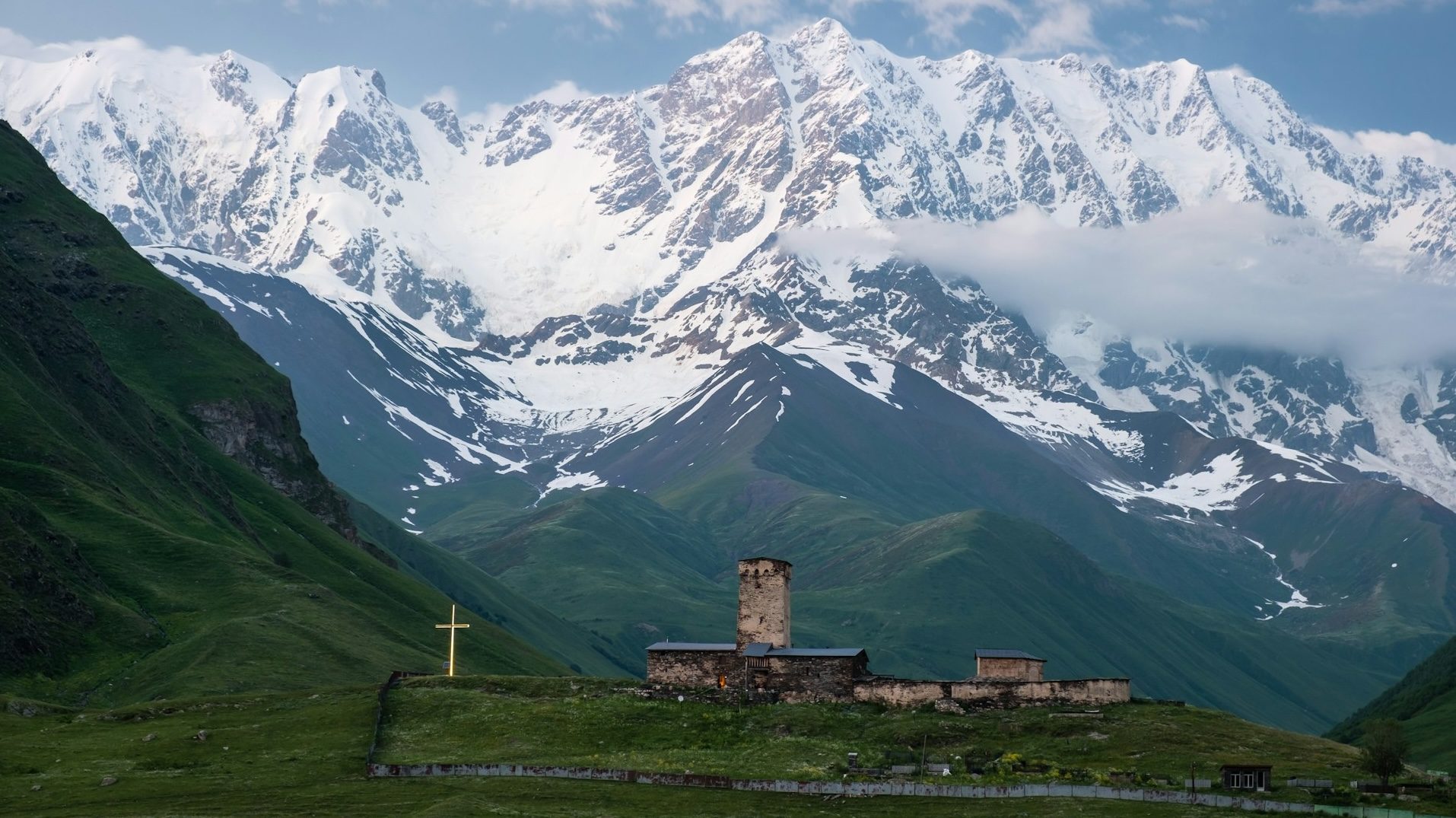
Svaneti sits in Georgia's northwest, in the high Greater Caucasus against the Russian border. The trek runs west to east along a chain of valleys from Mestia, the regional hub at roughly 1,500 m, to Ushguli at roughly 2,100 m, one of the highest continuously inhabited settlements in Europe and part of the Upper Svaneti UNESCO World Heritage Site inscribed in 1996.
Day 2 follows the Mulakhi valley east to Zhabeshi through hay meadows and birch woods, an easy opener at moderate elevation. Day 3 climbs steeply out of the valley over a saddle near Tsvirmi at roughly 2,150 m and drops into Adishi, a near-abandoned tower village sitting in an amphitheatre below its own glacier. Day 4 is the crux: ford the glacial Adishi river, climb to Chkhutnieri Pass at roughly 2,722 m, and descend a long way down to Iprari. Day 5 walks up the Enguri valley past Khalde to Ushguli, arriving under the white face of Shkhara.
The shape matters medically. The high point is crossed in daylight and every night is spent well below it, so this is a trek with a mountain profile and a lowland risk profile. What changes across the route is not oxygen, it is distance from help. Mestia has pharmacies, clinics, and an airport. By Adishi you are a hard day from that, and past Chkhutnieri Pass, backtracking to Mestia means retracing a day or more of trail or paying for a rough transfer that weather can cancel. Everything in the health plan below follows from that one geographic fact.

Day-by-day plan
Day 1: Arrive Tbilisi, travel to Mestia
Georgia's international gateway is Tbilisi, at roughly 450 m. Getting to Svaneti from there is the part first-timers underestimate. The fastest option is a domestic flight into Queen Tamar Airport, a couple of kilometres from Mestia, though mountain weather cancels these often enough that you should not build a tight schedule on one. The reliable overland version is the train to Zugdidi, roughly 6 hours, then a marshrutka or shared taxi on to Mestia, another 3 to 4 hours.
Whichever way you arrive, spend the evening in Mestia deliberately. Confirm your route, check the pass conditions with your guesthouse host, and take stock of your medical kit. This is the last town on the itinerary with a pharmacy, and the practical answer is to arrive already carrying what you need rather than shopping for it in a language you do not read.
Day 2: Mestia to Zhabeshi
Roughly 15 km east along the Mulakhi valley, gentle by the standards of what follows, with tower villages and hay meadows most of the way and a finish at Zhabeshi around 1,650 m. Use it as a calibration day for pace, pack weight, and boots.
Tonight is also your first guesthouse dinner, and the food-safety habits you set now carry for four days. The lower-risk end of a Svaneti table is anything hot and freshly cooked, served straight from the pot. The higher-risk end is the room-temperature salad, the dairy of uncertain provenance, and untreated tap water. Most trekkers should filter, boil, or treat drinking water rather than trusting village supply, which is standard CDC guidance for rural travel and costs you nothing but a few minutes.
Day 3: Zhabeshi to Adishi
The trail leaves Zhabeshi and climbs hard through forest to a saddle near Tsvirmi at roughly 2,150 m, then descends into Adishi at roughly 2,040 m, a cluster of stone towers set below the Adishi glacier. Distance runs around 13 to 16 km depending on the variant, and the descent is long enough to find whatever your knees have been hiding.
This is where an anti-inflammatory plan earns its place. Rx-strength ibuprofen is a reasonable thing to carry for descent-related knee and ankle soreness on a trek like this one, taken with food and within the limits your provider sets. Trekking poles do more than any medication here, so if you have them, use them from the top of the descent rather than after the pain starts.
Want the health prep for Georgia?
Get a 60-second pre-trip check: the vaccines, prescriptions, and altitude/seasonality notes that change the plan — built for your exact dates.
Day 4: Adishi over Chkhutnieri Pass to Iprari
The biggest day, roughly 17 km with about 950 m of climbing. An hour past Adishi the trail meets the glacier's outflow river, cold, fast, and unbridged. Local horsemen wait at the crossing in high season, typically from around 25 lari per person, and taking the horse is usually the right call. Getting soaked at the base of a climb to 2,722 m means hours of walking wet and cold with no shelter above you.
From there the trail climbs steadily to Chkhutnieri Pass at roughly 2,722 m, the high point of the trek, then makes a long descent toward Iprari. You cross the pass and sleep several hundred metres below it, which is why altitude illness is not the defining risk of this route. What is defining is isolation. This is the single worst day on the trek to be dehydrated, cramping, or running to the bushes, because there is no road, no clinic, and no shortcut off the mountain between the two villages.

Day 5: Iprari to Ushguli
Roughly 13 km up the Enguri valley, past the hamlet of Khalde, to Ushguli at roughly 2,100 m. It is the gentlest of the four trekking days and the most rewarding: the valley opens onto a community of four villages holding more than 200 medieval defensive towers, with Shkhara, one of the highest summits in the Caucasus, closing the head of the gorge.
Give yourself the afternoon here rather than pushing straight out. Ushguli is the point of the whole route, and the walk up toward the Shkhara glacier viewpoint is worth the extra couple of hours if your legs have anything left.
Day 6: Ushguli to Mestia, onward to Tbilisi
Shared four-wheel-drive vehicles run the roughly 45 km of rough mountain road from Ushguli back down to Mestia, a slow and genuinely bumpy two to three hours. From Mestia, connect to your flight or the road and rail route back toward Tbilisi.
One practical note: the trek will not make you motion sick, but this drive might. If you know you are prone to car sickness on winding gravel, sit forward, keep your eyes on the horizon, and raise it with your provider before the trip so you are not improvising in the back of a Delica.
Health prep for this trip
Start with routine coverage. The CDC recommends that all international travelers be up to date on measles vaccination with MMR, and a travel health visit is the right place to confirm that alongside hepatitis A, typhoid, and, for rural travel with animal contact, a conversation about rabies. Book that visit at least four to six weeks out so there is time for anything that needs a series.
The prescription layer is where this trek differs from a Tbilisi city break. Most trekkers doing four days past the last pharmacy should discuss carrying standby self-treatment for traveler's diarrhea. The Svaneti travel-medicine bundle covers the three that map to this route: azithromycin for bacterial TD, at the CDC-listed 500 mg daily for three days regimen Wandr's clinicians use, Rx-strength ibuprofen for descent-related joint pain, and dicyclomine for the cramping that often outlasts the diarrhea itself. Standby means exactly that: you carry it, and you use it for moderate to severe illness on the advice of the provider who prescribed it, not for one uncomfortable morning.
Two things no prescription covers. Insect precautions matter, because the CDC notes that ticks and mosquitoes in Georgia can spread illnesses that no vaccine or pill prevents, so plan on repellent and a nightly tick check. And confirm your travel insurance explicitly covers trekking to 3,000 m with emergency evacuation, since a helicopter off the Chkhutnieri side is not a bill you want to discover uninsured.
What to pack
- Broken-in boots with real ankle support, plus trekking poles for the descents into Adishi and the Enguri valley
- Water filter or purification tablets, and a bottle you will actually refill
- Rain shell and a warm layer, because 2,722 m has its own weather regardless of the forecast in Mestia
- Your clinician-reviewed travel-medicine kit: azithromycin, Rx-strength ibuprofen, dicyclomine
- Oral rehydration salts, the single most useful non-prescription item on this trek
- Hand sanitizer for the trail and before every guesthouse meal
- Cash in lari, since card acceptance past Mestia is unreliable and the river horsemen do not take cards
- Insect repellent and a headlamp
Best time to go and what to avoid
The window is narrower than Georgia's general tourist season because the pass and the guesthouses both have to be open.
Two avoidance rules worth holding. Do not schedule the pass day with no buffer, because one bad-weather day in Svaneti can cost you the crossing. And do not treat the July and August high season as the safest option health-wise. Busier guesthouse kitchens with faster turnover are precisely the conditions under which food-borne illness spreads, which is the argument for September if your schedule allows it.
Cost expectations
Svaneti is inexpensive by European trekking standards. Guesthouses along the route typically run in the range of 60 to 120 lari per person per night with dinner and breakfast included, the Adishi horse crossing starts around 25 lari, and the shared 4x4 from Ushguli back to Mestia is usually a few tens of lari per seat. Domestic flights to Mestia are cheap when they operate; the rail-and-marshrutka route is cheaper still and more reliable. Guided packages cost several times the independent version and mostly buy you logistics and language rather than technical support.
Day-by-day plan
| Day | What you're doing | Health note |
|---|---|---|
| 1 | Arrive Tbilisi, travel to Mestia Land in Tbilisi (roughly 450 m), then cross the country to Mestia (roughly 1,500 m) by domestic flight or by the Zugdidi rail-and-road combination. Gear check, guesthouse dinner, early night. | Mestia is the last town on this route with a pharmacy. Anything you have not brought or bought by tonight, you are walking without. |
| 2 | Mestia to Zhabeshi First trekking day, roughly 15 km east along the Mulakhi valley through birch forest and hay meadows to the tower village of Zhabeshi (roughly 1,650 m). | Your first guesthouse dinner is also your first food-safety decision. Hot, freshly cooked, and served straight from the pot is the low-risk end of the menu. |
| 3 | Zhabeshi to Adishi A steep forested climb out of the valley, over a saddle near Tsvirmi at roughly 2,150 m, then down into the natural amphitheatre of Adishi (roughly 2,040 m) beneath its glacier. | Long descent day. Rx-strength ibuprofen is worth having for knees that are not used to this many downhill kilometres in a row. |
| 4 | Adishi over Chkhutnieri Pass to Iprari The biggest day, roughly 17 km. Ford the glacial Adishi river (most trekkers pay a local for a horse crossing), climb to Chkhutnieri Pass at roughly 2,722 m, then descend the long way to Iprari. | The highest point of the trek, crossed in daylight and slept well below. Cold, fast glacial water and a full day from any road, so this is the worst possible day to be sick. |
| 5 | Iprari to Ushguli Roughly 13 km up the Enguri valley past Khalde to Ushguli (roughly 2,100 m), a UNESCO-listed cluster of villages with more than 200 medieval tower houses under Mount Shkhara. | Two nights of altitude at 2,100 m is still below the CDC's acute mountain sickness threshold. Expect tired legs, not altitude symptoms. |
| 6 | Ushguli to Mestia, onward to Tbilisi Shared 4x4 back down the roughly 45 km of rough mountain road to Mestia, then the flight or road transfer back toward Tbilisi and your outbound flight. | A winding four-wheel-drive descent on gravel. If you are prone to car sickness, this is the leg where it shows up, not the trail. |
Frequently Asked Questions
For Tbilisi, Batumi, and the wine country, usually not. Georgia is a comparatively low-risk destination by CDC baseline criteria, and most city travelers do fine with food and water precautions alone. The Mestia-to-Ushguli trek is a different exposure. You are eating family-style meals in village guesthouses with rotating home cooks, sharing bathrooms, and walking four consecutive days with no road access in between. The CDC puts traveler's diarrhea attack rates at 30 to 70 percent over a two-week trip depending on destination and season. Most trekkers should talk to a provider about carrying a standby antibiotic rather than relying on finding one mid-route.
For most trekkers, no. The high point is Chkhutnieri Pass at roughly 2,722 m, and it is crossed during the day rather than slept on. The overnight villages sit roughly between 1,400 and 2,200 m, and Ushguli itself is around 2,100 m. The CDC associates acute mountain sickness with unacclimatized travelers sleeping at or above roughly 2,500 m, so this route stays under that line every night. If you have had altitude illness at modest elevations before, or you have a cardiopulmonary condition, that is worth raising with a provider before you book.
Azithromycin is the usual choice for this part of the world. The CDC Yellow Book lists azithromycin 500 mg daily for three days as a standard regimen, alongside single-dose options. Wandr's clinicians prescribe the 500 mg three-day course. It is intended as standby self-treatment for moderate to severe symptoms, not something you take at the first loose stool. A licensed provider will confirm whether it is appropriate for you and review any drug interactions during your visit.
On day 4 the trail meets the glacial outflow of the Adishi glacier, which runs fast and very cold. Most trekkers pay a local horseman from Adishi to carry them across, a service that runs in the range of 25 lari and up per person in high season. Some people wade it. The practical health argument for the horse is that a soaking at the start of a 17 km day that climbs to 2,722 m leaves you cold and wet for hours with no shelter, and a slip in swift water is a real injury risk.
Mid-June to late September is the working window. Snow can linger on Chkhutnieri Pass into early June, and guesthouses in the smaller villages start closing in October. July and August are the warmest and busiest. September often brings the clearest air and the emptiest trail, with colder nights and a higher chance of an early snow event on the pass. Whatever month you choose, plan for the weather to change fast at 2,700 m.
The route is walkable unguided by experienced hikers, with a well-established village guesthouse network at every overnight stop. Meals are typically included and served family-style. That network is exactly why the food-safety plan matters: your dinner is cooked in a home kitchen by a different family every night. A guide adds route-finding help in poor visibility and local language on the day something goes wrong, which is worth more on this trek than the terrain alone suggests.
No. WHO certified Georgia malaria-free in January 2025, and no chemoprophylaxis is indicated for this trip. The CDC does still flag insect precautions in Georgia, since ticks and mosquitoes there can carry illnesses that no vaccine or pill prevents. On a Svaneti trek that means repellent, tucked socks in tall summer grass, and a tick check at the end of each day.
That is the scenario this itinerary is built around. From Adishi or Iprari, returning to the pharmacy in Mestia means reversing a day or more of trail or arranging a costly private transfer on a road that is not always passable. Carrying azithromycin, Rx-strength ibuprofen, and dicyclomine means that a bad gut day is usually a rest day at a guesthouse rather than an evacuation. Warning signs that call for real medical care rather than self-treatment include a high fever, blood in the stool, or an inability to keep fluids down, and those should prompt getting off the trail.
Moderately. The distances run roughly 13 to 17 km a day with 500 to 1,000 m of ascent and similar descent, on trail rather than technical terrain. If you can comfortably walk 15 km on hills with a daypack on consecutive days, you are in range. The descents punish knees more than the climbs punish lungs, which is why trekking poles and an anti-inflammatory plan matter more here than any altitude preparation.
The Wandr Team is the editorial group at Wandr Health; every article is reviewed by a licensed clinician before publication.