
The 8-Day Mongolia Gobi Desert Itinerary: The Health-Smart Version

Mongolia's Gobi Desert is safe to travel but genuinely remote: a week of jeep travel between ger camps can put you a half-day's drive from the nearest hospital in Dalanzadgad, itself roughly 540 km from Ulaanbaatar. Build this 8-day loop around three prescriptions instead of pharmacy access: azithromycin for traveler's diarrhea, which the CDC places in the 30-70% range on 2-week trips through this region, plus ondansetron and dicyclomine for the nausea and cramping that come with long unpaved jeep legs between Yolyn Am, the Khongoryn Els dunes, and the Flaming Cliffs. "In the Gobi, your travel-medicine kit is your safety net, not a backup plan," says Dr. Alec Freling. Pack it before you fly to Ulaanbaatar, not after you land.
Mongolia's Gobi Desert rewards travelers who plan around distance, not altitude or malaria. There's no antimalarial to pack and no acclimatization schedule to build in. Instead, the real health variable is how far you are from care once you leave Ulaanbaatar: jeep legs of 180 to 400 km between ger camps, roads that shake loose whatever your stomach was already unsure about, and a regional hospital in Dalanzadgad that can be a half-day's drive from a western Gobi camp. This 8-day loop through Yolyn Am, the Khongoryn Els dunes, the Flaming Cliffs, and Erdene Zuu Monastery treats a travel-medicine kit as core gear, not an afterthought.
Who this itinerary is for
This route suits travelers who are comfortable with long unpaved drives and basic ger-camp accommodation in exchange for landscapes that most itineraries only glimpse from a plane window. First-time visitors to Mongolia should expect several consecutive days without reliable cell signal or a nearby clinic, and should build their expectations around that reality rather than around trip-planning assumptions carried over from more developed destinations. Most operators run this loop as a small shared group in a Russian-style 4x4 or minivan, typically four to six travelers per vehicle, which shapes the pace: everyone's health decisions on a given day (whether to push on, rest, or turn back) affect the group.
Returning travelers who have handled long-haul Southeast Asia or East Africa trips will recognize the pacing: a couple of orientation days in the capital, then a string of transit-heavy days broken up by a genuinely spectacular stop. Fitness needs are modest (walking on sand, short scrambles, a camel ride) but the tolerance for vehicle time needs to be real, often five or more hours a day on the longest legs. Anyone prone to motion sickness or with a history of severe traveler's diarrhea should talk to a provider before booking, since both risks are structural to this route, not incidental to it.
The route
The loop starts and ends in Ulaanbaatar, with two capital days bookending a six-day run through the South Gobi and a swing north through central Mongolia on the way back. After orientation in the capital, the fastest way into the desert is a roughly 540 km flight to Dalanzadgad rather than the 8-plus-hour drive covering similar ground, a choice that trades a scenic overland day for lower fatigue on a trip that has plenty of long driving days ahead of it anyway.
From Dalanzadgad, the route runs west through Gobi Gurvan Saikhan National Park: first to Yolyn Am's shaded ice gorge, then a roughly 180 km jeep leg to the Khongoryn Els dunes, then another 180 km to the Bayanzag Flaming Cliffs. From there the itinerary turns north for the longest single drive, 370 to 400 km, to Kharkhorin and the Erdene Zuu Monastery, before a final 380 km run back to Ulaanbaatar. Every one of those legs is on a mix of paved and unpaved road, several of them stacking five-plus hours of driving into a single day, and the accumulated vehicle time is the itinerary's real health variable, not any single site.

Day-by-day plan
Day 1: Arrive Ulaanbaatar, settle in and set the health baseline
Land in Ulaanbaatar, at roughly 1,350 meters, low enough that altitude is a non-issue for the rest of the trip. Use the afternoon to adjust to the time change, get cash in Mongolian togrog, and go through your travel-medicine kit before you're anywhere near a pharmacy that stocks what you'd need.
Day 2: Ulaanbaatar city day: monasteries, the square, and street-food ground rules
Spend the day at Gandantegchinlen Monastery, Sukhbaatar Square, and the National Museum of Mongolia. This is also the day to decide your food and water rules for the rest of the trip. The CDC places Mongolia in the 30 to 70 percent traveler's diarrhea range on two-week trips, and much of that risk traces to exactly the kind of street food on offer here, khuushuur (fried meat pastry) and buuz (steamed dumplings) among them. Most travelers should eat food that's served hot, stick to bottled or treated water, and carry azithromycin rather than assume a light Ulaanbaatar meal is automatically low-risk. If your dates land around July 11-13, Mongolia's national Naadam Festival (wrestling, archery, and horse racing) runs in the capital, which is worth building a buffer day around if it interests you.
Day 3: Fly to Dalanzadgad, drive into Gobi Gurvan Saikhan National Park
A roughly 1.5-hour flight covers the same ~540 km that would otherwise take 8 or more hours by road. From Dalanzadgad, transfer to Yolyn Am (Vulture Valley), a narrow gorge in the Gurvan Saikhan mountains where shaded ice can persist into July despite the surrounding desert. This is your first ger camp night, and a good time to confirm where the nearest clinic actually is: Dalanzadgad's regional hospital, itself roughly 540 km from the capital and, once you're moving between camps, often a half-day's drive from wherever you're actually sleeping.
Day 4: Yolyn Am ice gorge, then the long jeep leg to Khongoryn Els
Walk into the gorge in the morning, then set out on the roughly 180 km unpaved drive to Khongoryn Els. Most travelers should take dicyclomine or ondansetron ahead of departure if motion sickness is a known issue, not after the washboard road has already started working on your stomach. This is the first of several multi-hour transit days back to back.

Want the health prep for Mongolia?
Get a 60-second pre-trip check: the vaccines, prescriptions, and altitude/seasonality notes that change the plan — built for your exact dates.
Day 5: Khongoryn Els, the singing dunes
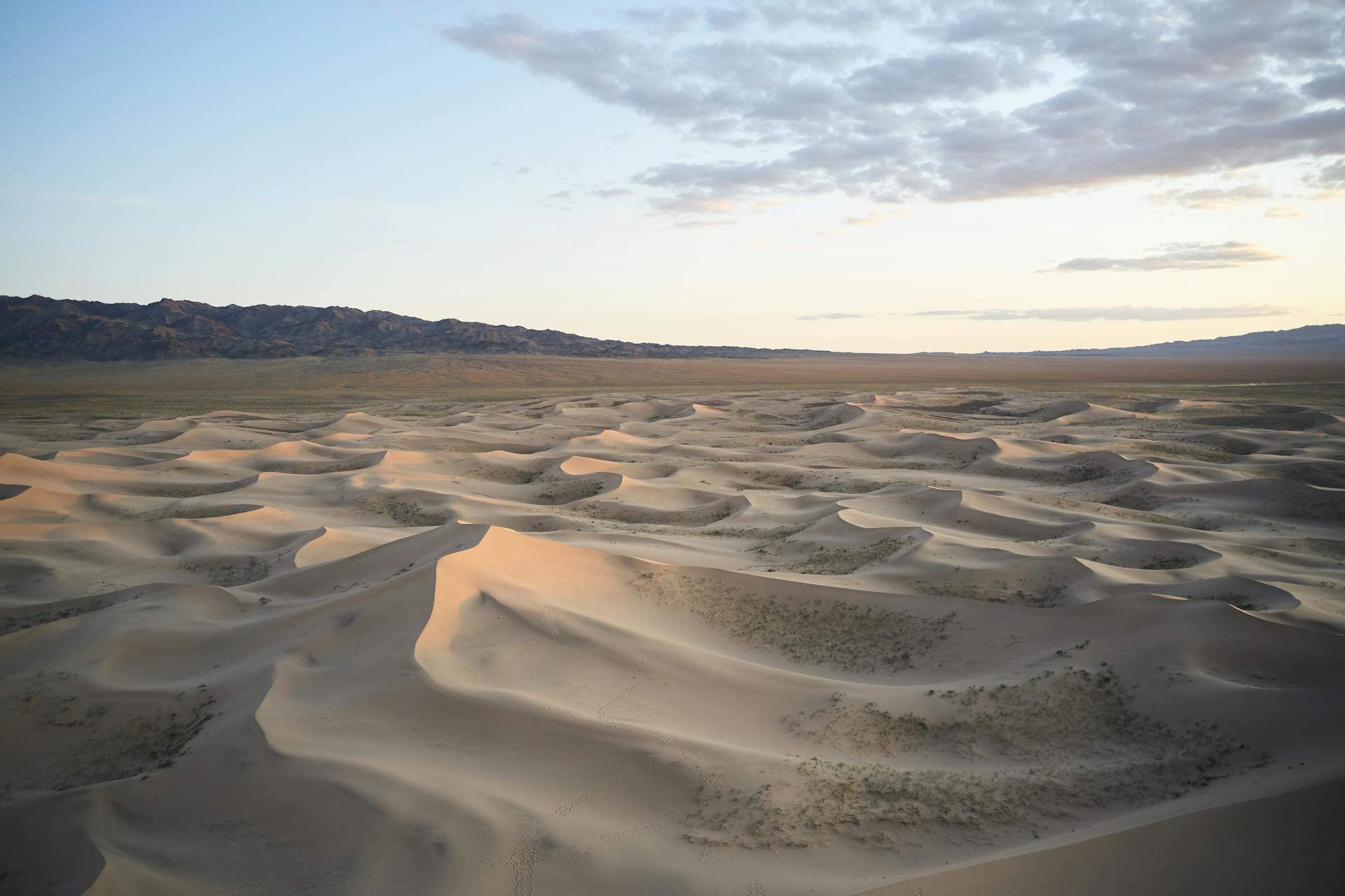
Khongoryn Els stretches roughly 180 km along the edge of the Altai range and rises up to 300 meters in places, among the tallest dune systems in Mongolia. Spend the day climbing the dunes, taking a camel trek at the base, and watching the light change at sunset. After yesterday's long drive, this is a lower-transit day: a good point to rehydrate deliberately, since dry desert air pulls moisture out of you faster than thirst alone will signal.
Day 6: Bayanzag, the Flaming Cliffs
Drive roughly 180 km to Bayanzag, the eroded red sandstone cliffs where paleontologist Roy Chapman Andrews's 1922 expedition uncovered the first known nest of dinosaur eggs, a discovery that put Mongolia at the center of global paleontology. Health-wise, this is a good day to reinforce two habits: hand hygiene before eating, and avoiding contact with wild rodents. Mongolia's National Center for Zoonotic Diseases issued a bubonic plague warning in mid-2026 after infected marmots were seized in several western provinces, a reminder that the animal is a real, if uncommon, disease vector in parts of the country this season.
Day 7: Long drive north to Kharkhorin and Erdene Zuu Monastery
This is the longest single driving day of the trip, roughly 370 to 400 km north to Kharkhorin, site of the 13th-century Mongol capital. Redose motion-sickness medication before setting out. The reward at the end is Erdene Zuu Monastery, built in 1585 to 1586 using stones scavenged from the ruined capital, its wall originally designed to carry 108 stupas, a sacred number in Buddhist tradition.
Day 8: Return to Ulaanbaatar and depart
A final roughly 380 km drive back to the capital, with time to shower, repack, and get to the airport. Keep your azithromycin course accessible for another week or two after you're home. Traveler's diarrhea and other GI symptoms can show up after you've already unpacked, and having the prescription on hand beats a same-day scramble.
Health prep for this trip
Start with our Mongolia destination guide for the baseline CDC guidance, then build outward from there. Most travelers should book a travel medicine consult about six weeks out. The CDC recommends Hepatitis A and Typhoid vaccination for most people visiting Mongolia, since both transmit through contaminated food or water, and suggests discussing rabies and tick-borne encephalitis vaccination if your trip extends into rural or remote areas beyond this itinerary's main route. There is no malaria risk in Mongolia per CDC guidance, and no yellow fever vaccination requirement for direct travel from the US, so neither belongs in a standard Gobi kit.
The trip's real prescription needs are structural rather than exotic: azithromycin for traveler's diarrhea (see the Mongolia Gobi Adventure travel medicine bundle), plus ondansetron and dicyclomine for the nausea and cramping that come with several consecutive long unpaved drives. Order these roughly two weeks out so they're in your duffel before you fly, not on a list of things to look for once you've landed. Azithromycin is most useful started at the first loose, urgent stool rather than saved for a worst-case scenario.
What to pack
Layer for a temperature swing that can hit 35 degrees Celsius between a hot afternoon and a cold desert night, even outside peak summer. Bring sun protection (hat, high-SPF sunscreen, sunglasses), a dust mask or buff for windy jeep days, a headlamp for ger camps without reliable power, and hand sanitizer or wet wipes for the meals between proper handwashing opportunities. Pack a few days' worth of small-denomination togrog, since rural stops don't take cards, and bring a universal adapter and a portable phone battery, since charging options thin out west of Dalanzadgad. Closed, sturdy shoes make the dune climb at Khongoryn Els considerably easier than sandals, and a lightweight sleeping bag liner is worth adding since ger camp bedding quality varies camp to camp.
Best time to go and what to avoid
Months | Conditions | What it means for you |
|---|---|---|
Dec-Feb | Extreme cold, many Gobi routes limited | Not a practical window for this itinerary |
Mar-Apr | Warming but windy, dust storms increase | Possible but visibility and comfort are inconsistent |
May-Jun | Warm days, cooler nights, good visibility | One of the two best windows for this route |
Jul-Aug | Hottest months, daytime highs near 40 degrees Celsius | Naadam Festival runs July 11-13 in Ulaanbaatar if timing allows a detour, but midday desert heat is intense |
Sep-Oct | Cooling again, clear skies, fewer crowds | The second best window, similar comfort to spring |
Nov | Cold sets in quickly | Most operators are winding down for the season |
Cost expectations
An organized 8-day Gobi loop with a driver, guide, ger camp lodging, and the internal Dalanzadgad flight typically runs from several hundred to around $1,500 to $2,000 per person, depending on group size, vehicle, and camp comfort level, on top of international airfare to Ulaanbaatar. Budget travelers joining a shared jeep group typically land toward the lower end of that range; private tours with a dedicated vehicle and higher-comfort ger camps run higher. The Ulaanbaatar-Dalanzadgad flight adds a modest cost that most travelers should treat as worthwhile given the alternative driving time, and it is usually simpler to book the whole loop, flights included, through a single local operator rather than piecing it together.
Day-by-day plan
| Day | What you're doing | Health note |
|---|---|---|
| 1 | Arrive Ulaanbaatar, settle in and set the health baseline Land in Ulaanbaatar (roughly 1,350 m) and settle into the city for the night. | No altitude concern at this elevation. Use today to reset your sleep schedule and confirm your travel-medicine kit before heading into the countryside. |
| 2 | Ulaanbaatar city day: monasteries, the square, and street-food ground rules A full day in the capital: Gandantegchinlen Monastery, Sukhbaatar Square, and the National Museum of Mongolia. | This is the day to set your food and water rules for the whole trip. CDC places Mongolia's traveler's diarrhea risk in the 30-70% range on 2-week trips. |
| 3 | Fly to Dalanzadgad, drive into Gobi Gurvan Saikhan National Park A short flight south to the Gobi's gateway town, then a transfer to Yolyn Am (Vulture Valley) for your first ger camp night. | The regional hospital in Dalanzadgad sits roughly 540 km from Ulaanbaatar and, once you're camp-hopping, is often a half-day's drive from where you're actually staying. Carry your prescriptions rather than count on finding a pharmacy. |
| 4 | Yolyn Am ice gorge, then the long jeep leg to Khongoryn Els Walk into the shaded gorge, where ice can persist into July, then drive roughly 180 km of unpaved road to the singing dunes. | Take motion-sickness medication before departure, not after nausea starts. This is the longest transit day so far. |
| 5 | Khongoryn Els: the singing dunes A full day at dunes that rise up to 300 meters, with a camel trek at the base and a dune-top sunset. | Dust and dry desert air raise dehydration risk faster than most travelers expect. Hydrate on a schedule, not by thirst. |
| 6 | Bayanzag, the Flaming Cliffs Drive roughly 180 km to the red sandstone cliffs where the first dinosaur egg nest was discovered in 1922. | Keep up bite-avoidance and hand-hygiene habits. Contact with wild rodents, including marmots, is a real and currently active health advisory in parts of Mongolia this season. |
| 7 | Long drive north to Kharkhorin and Erdene Zuu Monastery The longest driving day of the trip, roughly 370 to 400 km, ending at Mongolia's oldest Buddhist monastery on the site of the ancient Mongol capital. | Redose motion-sickness medication before this leg. It is the single longest drive of the itinerary. |
| 8 | Return to Ulaanbaatar and depart A final drive back to the capital, roughly 380 km, with time to repack before your flight home. | Watch for delayed-onset GI symptoms in the 1-2 weeks after you return. Keep your azithromycin course on hand until you're confident you're clear. |
Frequently Asked Questions
No. The CDC does not list malaria as a risk in Mongolia, so an antimalarial is not part of a standard Gobi kit. Confirm with your provider if your itinerary adds a different country.
Beyond routine vaccines, the CDC recommends Hepatitis A and Typhoid for most travelers to Mongolia, since both spread through contaminated food or water. Rabies and tick-borne encephalitis vaccination are worth discussing with a provider if you're extending into remote rural areas.
Generally no. Ulaanbaatar sits at roughly 1,350 m, and most Gobi routes stay well under the 2,500 m mark where acute mountain sickness typically becomes a concern. Yolyn Am's gorge walls climb higher, but the standard visitor route does not require altitude medication.
The CDC places Mongolia in the 30-70% traveler's diarrhea range for 2-week trips. Shared ger-camp kitchens, limited refrigeration in remote areas, and unfamiliar food handling all raise the odds. Most travelers should carry a self-treatment course rather than plan to find a pharmacy mid-trip.
In mid-2026, Mongolia's National Center for Zoonotic Diseases issued a warning after infected marmots were seized in the western provinces, noting that 17 of the country's 21 provinces are considered at risk. Plague spreads via fleas on wild rodents, not person to person in this context. The practical takeaway for travelers: don't touch, hunt, or eat marmots, and mention any rural rodent contact to a provider if you develop fever after your trip.
Most travelers should fly. The route runs roughly 540 km, about a 1.5-hour flight versus 8 or more hours of driving on rougher roads. Flying trades a scenic overland day for lower fatigue and less road exposure, which matters more on a trip already built around several long unpaved jeep legs.
May-June and September-October are generally the most comfortable windows, before and after the harshest summer heat. Summer days can push toward 40 degrees Celsius, and the desert's daily temperature swing can hit 35 degrees Celsius between day and night even in the warm months.
Dicyclomine and ondansetron cover the cramping and nausea most travelers report on Mongolia's unpaved Gobi roads. Take them ahead of a known long leg rather than waiting for symptoms, and pair medication with practical steps: a window seat, steady hydration, and short breaks on multi-hour drives.
Alec Freling, MD is a board-certified emergency medicine physician and co-founder of Wandr Health with ER experience treating returning travelers.