
Travel Health Guide: Aruba — Outside the Hurricane Belt, Mosquito-Light, and the Things US Travelers Still Skip
A physician-reviewed travel health guide to Aruba. Vaccines, dengue and chikungunya risk in the arid ABC islands, hurricane-belt safety, sun and marine hazards.
Travel Health Guide: Aruba — Outside the Hurricane Belt, Mosquito-Light, and the Things US Travelers Still Skip
Most US travelers heading to Aruba prepare for the wrong things. They worry about hurricanes, malaria pills, and yellow fever shots, then walk off the plane unprotected against the actual risks: sunburn at a UV index of 11, dehydration, hepatitis A from off-resort meals, dengue picked up after dusk, and a measles exposure on the flight in. There are no legally required vaccines for US citizens entering Aruba, but the CDC still recommends hepatitis A, a current MMR, Tdap, polio, flu, hepatitis B, and chikungunya for most travelers, and selective typhoid and rabies for off-resort itineraries. Aruba sits at roughly 12 degrees north latitude, well outside the Atlantic hurricane belt, and its arid climate keeps mosquito-borne disease pressure markedly lower than the Dominican Republic, Jamaica, or Puerto Rico, but year-round dengue and chikungunya transmission still exist. As a physician, I treat returning Aruba travelers for sunburn, sun-poisoning, food-borne illness, and dehydration far more often than anything exotic. This guide walks you through what actually matters before you go.
Quick Facts: Aruba at a Glance
- Region: Southern Caribbean (Dutch Kingdom, ABC islands)
- Latitude: ~12.5 degrees north (outside Atlantic hurricane belt)
- CDC vaccine recommendations: Routine vaccines current (MMR, Tdap, polio, varicella, influenza), plus hepatitis A, hepatitis B, chikungunya. Selective typhoid and rabies.
- Yellow fever: Not required for travelers arriving directly from the US. Required only if arriving from or transiting longer than 12 hours through a yellow fever risk country.
- Malaria: None. Aruba is malaria-free, no antimalarials needed for any itinerary.
- Dengue and chikungunya: Year-round transmission, lower pressure than other Caribbean islands but still present.
- Tap water: Safe to drink. Produced by reverse-osmosis desalination at W.E.B. Aruba and meets WHO drinking-water standards.
- Hurricane risk: Lowest in the Caribbean. Last hurricane to even graze Aruba was Felix in 2007.
- Sargassum: Largely unaffected. Bonaire acts as a windward shield and Aruba's trade winds push floating seaweed off the coast.
- US visitor volume: Roughly 73 percent of Aruba's stay-over visitors come from the US. Aruba welcomed about 1.25 million stay-over tourists in 2024 per the Aruba Tourism Authority, meaning roughly 900,000 to 940,000 US travelers arrived that year.
Why Aruba's Health Risk Profile Is Different From the Rest of the Caribbean
Most Caribbean destination guides repeat the same script: get hepatitis A, watch for dengue, beware of hurricane season. That script does not fit Aruba. Three geographic facts change the math.
Aruba sits at 12 degrees north latitude, outside the Atlantic hurricane belt. The hurricane formation zone and the Caribbean's major hurricane tracks sit well to the north. According to historical National Hurricane Center data, the most recent direct hurricane impact on Aruba was Felix in 2007, which caused minor damage. Hurricane Matthew in 2016 passed about 80 miles north of the island as a Category 2 storm. The practical implication for travelers: trip-cancellation pressure from hurricane risk that drives planning for the rest of the Caribbean (June through November) is dramatically lower for Aruba.
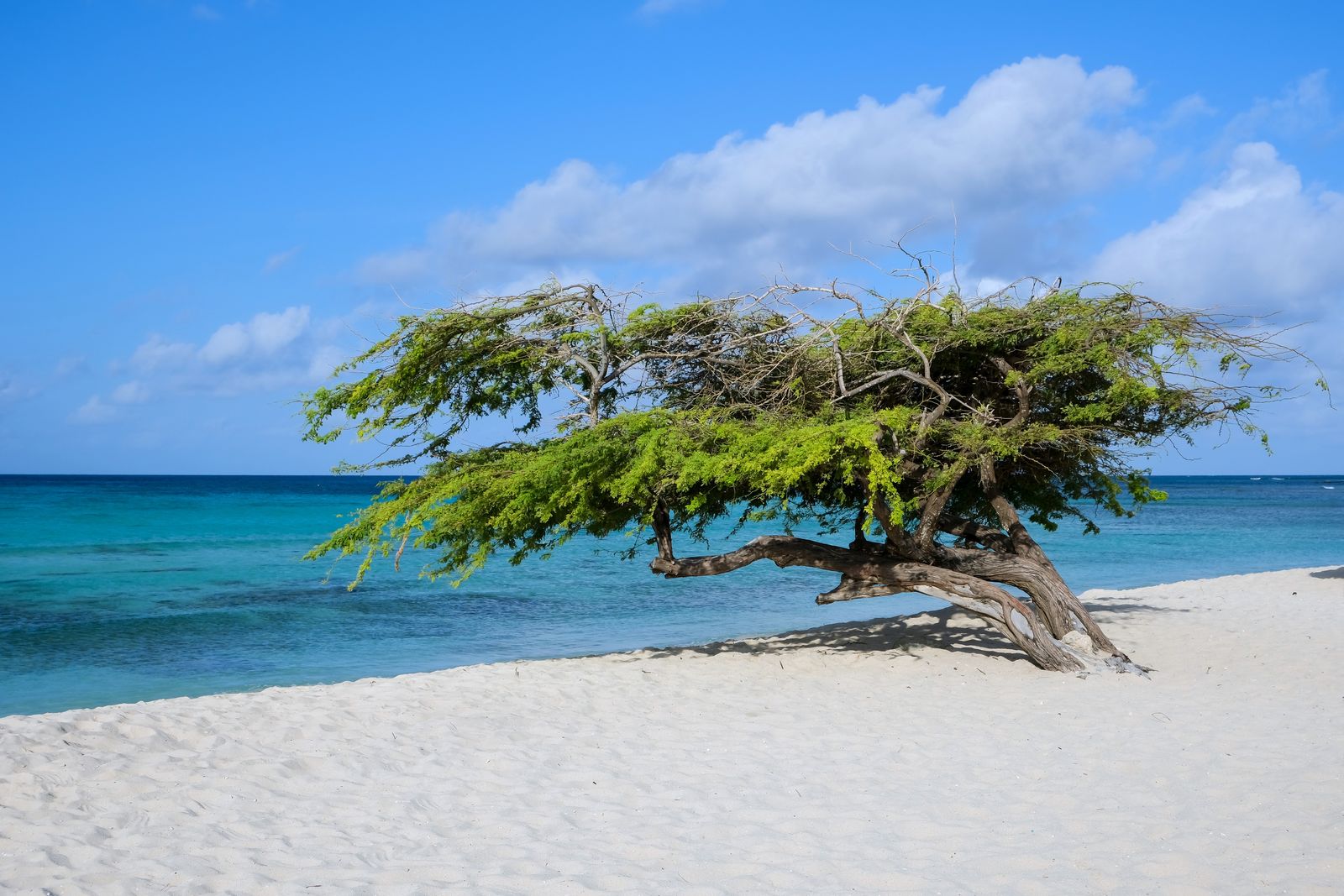
Aruba is a desert island, not a rainforest. Annual rainfall averages around 20 inches, mostly in short bursts between October and January. Cacti, divi divi trees, and arid scrub define the landscape. Aedes aegypti, the mosquito that transmits dengue, chikungunya, and Zika, breeds in standing fresh water, which is in short supply on Aruba compared to the Dominican Republic, Puerto Rico, Jamaica, or the Bahamas. The Caribbean subregion as a whole recorded a 7 percent increase in dengue cases through epidemiological week 48 of 2025 per PAHO surveillance, but transmission pressure on Aruba is consistently lower than on the larger, wetter islands.
The water is desalinated, not pumped from rivers or wells. Aruba has no natural freshwater sources, so all drinking water is produced through a multi-stage seawater reverse-osmosis process at the W.E.B. Aruba facility, which holds ISO 17025 lab accreditation and meets WHO drinking-water guidelines. Tap water in Aruba is safe to drink, including in resorts, restaurants, and from public fountains. This is unusual for the Caribbean and removes one major traveler's-diarrhea vector that drives guidance for destinations like Mexico, the DR, and most of Central America.
Those three facts do not eliminate health risk. They reshape it. The actual risks on Aruba are sunburn at a UV index of 11+, dehydration, alcohol-related accidents, marine envenomations, and food-borne illness from off-resort meals. The mosquito-borne risk is real but lower than on neighboring islands. The hurricane risk is essentially negligible for trip-planning purposes.
Vaccines for Aruba: What the CDC Actually Recommends
Aruba has no legal vaccine entry requirements for US travelers arriving directly from the US. That fact misleads travelers into skipping vaccination entirely. The CDC still recommends a specific set of vaccines for most travelers, and a few more for off-resort itineraries. Here is the full picture.
Routine vaccines every adult traveler should have current
- MMR (measles, mumps, rubella). The CDC issued a Level 1 Travel Health Notice ("Measles in the Globe") for international travelers in 2025 that remains active in 2026. As of May 14, 2026, the US had logged 1,893 confirmed measles cases this year. Adults born after 1957 should have two documented doses of MMR. Infants 6 to 11 months old who are traveling internationally should receive one early dose at least two weeks before departure. A Caribbean resort with international guests is exactly the kind of setting where measles imports happen.
- Tdap (tetanus, diphtheria, pertussis). A single Tdap booster, then a Td or Tdap every 10 years. If you have not had Tdap in over 10 years or do not remember, get one before you go.
- Polio. A single adult IPV booster if your routine series is complete and you have not had a travel booster. Aruba itself is polio-free, but ongoing wild and vaccine-derived poliovirus circulation in several countries makes booster status a sensible global hedge.
- Varicella, influenza, COVID-19. Current per the standard adult schedule.
Travel-specific vaccines the CDC recommends for most Aruba travelers
- Hepatitis A. Recommended for all travelers older than 1 year. One pre-departure dose provides roughly 95 percent protection. Give it at least two weeks before travel, ideally four or more. The risk is not the resort buffet, it is the street stand in San Nicolas, the local restaurant in Oranjestad, or the friend's house in Noord.
- Hepatitis B. The 2022 ACIP recommendation calls for universal hepatitis B vaccination for adults 19 to 59. For short-window travelers, Heplisav-B is a two-dose schedule (0 and 1 month) that can produce protective immunity faster than the older three-dose Engerix-B or Recombivax HB series. The Caribbean has intermediate hepatitis B prevalence, and any traveler considering medical or dental care, tattoo, piercing, or new sexual contact while abroad should be current.
- Chikungunya. Both Ixchiq (live-attenuated, 18+) and Vimkunya (virus-like particle, 12+) are FDA-approved. ACIP currently prefers Vimkunya for adults 65+ given a 2024-2025 safety signal with Ixchiq in older adults. Chikungunya is endemic to the Caribbean since the 2013-2014 outbreak, with ongoing transmission documented in the region in 2025.
Selective vaccines, depending on your itinerary
- Typhoid. Consider if you are staying with friends or family, eating at street stands frequently, traveling to less-touristed areas, or staying for more than two weeks. Two formulations exist: Vivotif (oral, four capsules) and Typhim Vi (one injection). Both are roughly 50 to 80 percent effective and not interchangeable with food safety.
- Rabies pre-exposure. Aruba's mongoose-and-stray-dog-driven canine rabies cycle is not a major concern, but bat-rabies exposure does occur. Pre-exposure prophylaxis is reasonable for cave explorers (Aruba's Quadirikiri and Fontein caves on the eastern coast contain bat colonies), wildlife photographers, and long-stay travelers. The modern two-dose intramuscular schedule (days 0 and 7) is now standard.
Vaccines that do NOT make sense for Aruba
- Yellow fever. Not required and not recommended unless you are arriving from a YF risk country (most of South America and sub-Saharan Africa).
- Japanese encephalitis. No transmission in Aruba.
- Meningococcal (ACWY). Routine adolescent schedule applies, but not a travel-specific need for Aruba.
- Antimalarials. None needed. Aruba is malaria-free.
For vaccines like hepatitis A, hepatitis B, typhoid, and chikungunya, Wandr books your travel vaccine appointment at a partner pharmacy near you. Pick a Walgreens location and time at the start of your booking, and the pharmacist administers the vaccine on-site under standing orders. No separate doctor's visit, no calling four pharmacies to check yellow card stock, and no driving 90 minutes to a travel clinic for a 5-minute injection.
→ Book your travel vaccines: travelwithwandr.com/vaccines
Yellow Fever and Aruba: The Transit-Country Rule Most Travelers Get Wrong
Aruba has a yellow fever entry rule that confuses travelers, particularly anyone connecting through South America. Here is how it actually works per the Aruba Department of Public Health.
No yellow fever vaccination is required if you are arriving directly from the United States. Period.
A valid International Certificate of Vaccination or Prophylaxis ("Yellow Card") is required if you are arriving from, or have stayed longer than 12 hours in, a yellow fever risk country in the 6 days before your arrival. The current Aruba list includes Argentina, Bolivia, Peru, Ecuador, Colombia, Brazil, Venezuela, Paraguay, Panama, French Guiana, Guyana, Suriname, Trinidad and Tobago, Angola, Benin, Burkina Faso, Burundi, Cameroon, Central African Republic, Chad, Congo, Democratic Republic of the Congo, Cote d'Ivoire, Equatorial Guinea, Ethiopia, Gabon, Gambia, Ghana, Guinea, Guinea-Bissau, Kenya, Liberia, Mali, Mauritania, Niger, Nigeria, Senegal, Sierra Leone, South Sudan, Sudan, Togo, and Uganda.
Airside transit shorter than 12 hours through a YF country does not trigger the requirement. You do not need a yellow card to make a 4-hour Bogota connection on the way to Aruba.
There is a 6-day rule. If you visited a YF country, then spent at least 6 consecutive days in a non-YF country before flying to Aruba, and developed no febrile illness in that window, you are exempt.
The vaccine must be administered at least 10 days before arrival to be valid. Once given, a single dose is now considered valid for life per WHO 2016 guidance. If you are coming to Aruba from a multi-stop South American trip, get your yellow fever shot before you leave the US. Wandr coordinates this through your local pharmacy and the documentation rules for the yellow card.
→ Learn more about the yellow fever vaccine for travelers.
Dengue, Chikungunya, and Zika on Aruba: The Real Mosquito Picture
The arid climate suppresses Aedes aegypti density, but the mosquito is present year-round on Aruba, and so are the three diseases it carries. The CDC currently lists Aruba as having current or past Zika transmission and recommends chikungunya vaccination for travelers.
Dengue: lower pressure than the rest of the Caribbean, but never zero
The 2024 PAHO dengue surge logged 13,063,434 cases across the Americas, the highest annual total since regional surveillance began in 1980. 2025 saw a 66 percent decrease in regional cases but a 7 percent increase in the Caribbean subregion. Aruba's case counts trail the Dominican Republic, Puerto Rico, and Jamaica by an order of magnitude, but year-round transmission is documented. Risk is highest after rainy spells, October through January, and around standing water (planters, cisterns, condensate trays).
Prevention is the only intervention. There is no FDA-approved dengue vaccine for US travelers. Use 20 to 30 percent DEET or 20 percent picaridin during daylight hours when Aedes is biting, treat clothing with permethrin, and stay in lodging with screens or air conditioning. If you developed a prior dengue infection in childhood or on a previous trip, mention it to your travel physician. Antibody-dependent enhancement makes second infections more dangerous.
Chikungunya: endemic since 2014, vaccine now available
Chikungunya entered the Caribbean in late 2013 and has been endemic since. The CDC and WHO recommend the chikungunya vaccine for Aruba travelers. Two FDA-approved options exist: Ixchiq (live-attenuated, single intramuscular dose, ages 18+) and Vimkunya (virus-like particle, single intramuscular dose, ages 12+). Vimkunya is preferred for adults 65 and older per current ACIP guidance. Both produce protective immunity around 14 days after vaccination.
Zika: low-level transmission, pregnancy precautions still apply
Zika transmission persists on Aruba at low levels, with no current outbreak. The CDC's standing recommendation remains in force: pregnant travelers should avoid travel to Zika-risk areas, and travelers planning conception should follow CDC guidance on waiting periods after travel (currently 2 months for women and 3 months for men). For non-pregnant travelers, the practical implication is the same as dengue and chikungunya: mosquito bite prevention is the intervention.
→ Read the complete physician's guide to dengue fever for travelers.
Hurricane Season on Aruba: Why It Is Different From the Rest of the Caribbean
Most Caribbean destination guides treat the June 1 to November 30 Atlantic hurricane season as a major planning factor. For Aruba, the calculation is different.
Aruba sits at roughly 12.5 degrees north latitude. Hurricanes form and intensify in the Atlantic main development region between roughly 10 and 20 degrees north, but the steering currents push them west and northwest, away from the southern Caribbean. Aruba, Bonaire, and Curacao sit just north of Venezuela, far enough south that the atmospheric conditions needed to sustain a hurricane rarely develop near them.
The historical strike rate is the lowest in the Caribbean. On average, a hurricane causing severe damage passes over or near the ABC islands roughly every 100 years. The most recent direct impact was Hurricane Felix in 2007 (minor damage), and the most recent close pass was Hurricane Matthew in 2016, which stayed about 80 miles north of the island.
Practical implication. Travelers comparing Aruba against Jamaica, the Bahamas, the Dominican Republic, Puerto Rico, or any of the Lesser Antilles for an August or September trip should weight hurricane risk much more heavily for the latter. The 2026 Colorado State University Atlantic hurricane forecast (released in April 2026) called for an above-average season with 12 to 15 named storms and 6 to 9 hurricanes. None of those typical tracks intersect Aruba.
That does not mean you can skip travel insurance. The 2026 NOAA outlook is one of dozens, tropical systems are inherently unpredictable, and a non-hurricane risk (medical evacuation, trip interruption from family emergency, COVID-19 quarantine in your country of origin) can derail any international trip. The reasoning is the same as for any Caribbean destination: travel insurance is cheap relative to medical evacuation or last-minute rebooking.
→ Read do I need travel insurance? when it's worth it and when it's not.
Sun, UV, and Heat: The Diagnoses I Actually See in Returning Aruba Travelers
Aruba's UV index runs at 11 or higher (rated "extreme") for most of the year, driven by latitude and minimal cloud cover. The trade winds keep ambient air temperature comfortable, which masks how much radiation is actually hitting skin. The result is the most common diagnosis I see in patients coming back from Aruba: significant sunburn, sometimes with second-degree blistering, and sun-related dehydration.
Sunscreen recommendations. Use mineral sunscreen (zinc oxide or titanium dioxide) at SPF 30 or higher, reapply every 90 minutes when wet or sweating, and use a broad-spectrum formula that blocks both UVA and UVB. Aruba banned oxybenzone and octinoxate sunscreens in 2020 to protect reef ecosystems, so check the label.
Hydration. Plan for 3 to 4 liters of water per day for an average adult, more for anyone exercising or drinking alcohol. The trade winds dry sweat quickly, which obscures fluid loss.
Heat illness signs to take seriously. Lightheadedness, nausea, confusion, headache, or stopping sweating in the heat are warning signs of heat exhaustion or heat stroke. Move into shade or air conditioning immediately, cool the skin with water, drink an oral rehydration solution, and seek medical care if symptoms do not resolve in 30 minutes or if mental status changes.
Marine Hazards: Lionfish, Sea Urchins, Jellyfish, Ciguatera
The same waters that make Aruba famous (visibility regularly exceeds 100 feet in summer) carry several specific risks worth knowing.
- Lionfish. Invasive throughout the Caribbean, present along Aruba's western coast. Spines inject a heat-labile venom that causes intense pain. First aid: immerse the affected area in hot water (around 110 to 115 F, hot but not scalding) for 30 to 90 minutes to denature the venom, remove visible spine fragments, and seek medical care for severe pain, infection, or systemic symptoms.
- Sea urchins. Long-spined urchins live on the rocky leeward shore and inside boat slips. Spines break off in the skin and embed; the toxin causes immediate burning. Soak in hot water, remove visible fragments with sterile technique, and watch for secondary infection.
- Jellyfish. Occasional sightings, mostly Portuguese man-of-war washed up by the trade winds. Treatment is rinsing with seawater (not fresh water, which can trigger remaining nematocysts), removing tentacles with a flat object, then hot-water immersion. Do not pour vinegar on a man-of-war sting; it is the wrong species for vinegar inactivation.
- Ciguatera. Reef-fish poisoning concentrated in large predator fish: barracuda, large grouper, large snapper, large amberjack. Symptoms include nausea, vomiting, diarrhea, then neurological symptoms (cold-hot temperature reversal, tingling) hours to days later. Resort restaurants are usually careful, but I would skip large-predator reef fish at street stands and off-resort kitchens.
- Boating accidents. Aruba's leeward coast is calm and friendly to novices, but the windward (eastern) coast has strong currents and the Andicuri and Boca Prins beaches are not safe for swimming. Watch posted warnings.
Traveler's Diarrhea on Aruba: Lower Risk, Different Pathogens
Tap water is safe. Resort kitchens follow EU-derived food safety standards. The result: traveler's diarrhea incidence on Aruba is meaningfully lower than on Mexico, the DR, or India. But "lower" is not "zero," and the pathogens you encounter on Aruba tilt different from Mexico's.
Most common Aruba TD pathogens are enterotoxigenic E. coli (ETEC), Campylobacter, and occasional norovirus from cruise-ship overflow.
Standby antibiotic guidance. For Caribbean travel, current Wandr clinical practice favors azithromycin 1,000 mg as a single dose, or 500 mg daily for 3 days, as the first-line antibiotic. Caribbean Campylobacter has rising fluoroquinolone resistance, which makes ciprofloxacin a weaker choice than for South or Southeast Asia. Loperamide can be added to slow gut transit; oral rehydration solution is the most important intervention regardless.
When to seek care. Bloody stools, fever above 102 F, signs of dehydration (low urine output, dark urine, lightheadedness), or symptoms lasting more than 3 days warrant medical evaluation.
For prescription travel medications, Wandr's clinicians review your destination and itinerary, then call the prescription in to your local pharmacy for pickup before you fly.
→ Read ciprofloxacin vs azithromycin for traveler's diarrhea: a physician's guide.
Sargassum on Aruba's Beaches: The Caribbean's Best Position
The Atlantic sargassum belt hit a record 37.5 million metric tons in May 2025 per University of South Florida Optical Oceanography Lab monitoring, the highest tonnage since satellite surveillance began. The 2025 inundation overwhelmed the eastern Caribbean (Barbados, St. Lucia, the US Virgin Islands) and the southern coasts of the Dominican Republic and Puerto Rico.
Aruba, by geographic luck, sits outside the main sargassum pathway. Bonaire takes the brunt of the southern arrival and acts as a windward shield for Curacao and Aruba. Aruba's persistent easterly trade winds (15 to 25 knots most of the year) push floating sargassum off the western tourist-beach coast where Eagle Beach, Palm Beach, Druif Beach, and Baby Beach sit. Some incidental sargassum landings occur on the eastern (windward) coast, particularly Baby Beach and Boca Grandi, but the leeward resort strip is largely unaffected even in record-influx years.
That said, weather is variable, and "largely unaffected" is not "never affected." If you have respiratory sensitivity, asthma, or COPD, follow Aruba Sustainability Trust live beach reports during your stay and avoid beaches with heavy decomposing sargassum (hydrogen sulfide off-gassing can trigger reactive airway disease).
Region-by-Region Health Risk on Aruba
Palm Beach and Noord (high-rise hotel strip)
Most US travelers stay here. Sun, dehydration, and alcohol-related accidents are the dominant risks. Tap water is safe, restaurants follow EU-derived food safety standards, and mosquito pressure is low because the resort district is heavily air-conditioned and screened. Carry sunscreen, water, and a reef-safe insect repellent for dusk dining.
Eagle Beach and Manchebo (low-rise strip)
Quieter, more residential. Same baseline risks as Palm Beach. Mosquito exposure modestly higher in the late-afternoon golden hour because of less artificial wind from high-rise buildings.
Oranjestad (capital, cruise port)
Walkable colonial city center, busy on cruise-ship days. Food safety from established restaurants is good; carry hand sanitizer for casual snacks and street stands. Pickpocketing is more common here than on resort beaches. Tap water is universally safe.
San Nicolas (south coast art district)
More local, less touristy. Hepatitis A risk creeps up at off-resort restaurants and street vendors. Typhoid is worth considering if your itinerary includes multiple meals here or in family-stay settings. Carry a TD antibiotic standby and an oral rehydration kit.
Arikok National Park (eastern interior, windward coast)
This is where Aruba's iconic divi divi trees, cacti, and rugged volcanic landscape live. Health considerations shift: sun exposure is more intense without ocean breeze (carry double water), the unpaved roads beat up rental cars, and the windward beaches (Boca Prins, Andicuri, Dos Playa) have strong currents and are not safe for swimming. The Quadirikiri and Fontein caves contain bat colonies; rabies pre-exposure prophylaxis is reasonable for travelers planning to explore caves.
Baby Beach and Rodgers Beach (southeastern tip)
Calm, shallow, family-friendly. Sun is unrelenting because of minimal shade. Occasional sargassum landings, particularly in May-October. Marine envenomation risk (sea urchins on rocky edges) for inattentive snorkelers.
Natural Pool / Conchi (north coast)
Reachable only by 4x4, ATV, horseback, or guided tour. Bring extra water, sun protection, and a basic first aid kit. The drive in is rough, and self-extraction in the event of an injury is hours, not minutes.
Renaissance Island (flamingo beach)
Private island accessible to Renaissance Hotel guests and day-pass purchasers. The famous flamingos are habituated and approachable but technically wild birds. Avoid hand feeding and watch children. Mosquito pressure is similar to the rest of leeward Aruba.
What I Tell My Patients Heading to Aruba: A Pre-Trip Checklist
- Two months out: Schedule a pre-trip health check. Verify MMR, Tdap, polio, hepatitis B, varicella, and flu status. Order hepatitis A, chikungunya, hepatitis B if not current, and typhoid if your itinerary calls for it.
- One month out: Get all recommended vaccines administered. Most produce protective immunity within 2 weeks, but hepatitis B accelerated schedules and the second-dose timing for some vaccines need lead time.
- Two weeks out: Pick up prescription travel medications (azithromycin TD kit, anti-nausea, anti-motion-sickness if needed) from your local pharmacy via Wandr.
- One week out: Buy reef-safe mineral sunscreen (oxybenzone and octinoxate are banned in Aruba), 20 to 30 percent DEET or 20 percent picaridin insect repellent, oral rehydration salts, and a basic first aid kit.
- Travel day: Carry vaccine documentation. Pack medications in carry-on, not checked, and keep them in original prescription bottles.
Aruba Packing Checklist (Health-Focused)
- Reef-safe mineral sunscreen, SPF 30+ (zinc oxide or titanium dioxide)
- 20-30% DEET or 20% picaridin insect repellent
- Permethrin-treated clothing for evenings
- Oral rehydration salts (4-6 packets)
- Standby azithromycin TD kit (prescription via Wandr)
- Loperamide (Imodium) for symptom control
- Acetaminophen and ibuprofen
- After-sun aloe or hydrocortisone cream
- Hand sanitizer
- Reusable water bottle (tap water is safe to fill)
- Basic first aid kit (bandages, antibiotic ointment, tweezers, blister patches)
- Any chronic prescription medications in original bottles, with a copy of the prescription
FAQ: Aruba Travel Health Questions Travelers Actually Ask
Do I need any vaccines to travel to Aruba?
There are no legally required vaccines for US citizens arriving directly from the US. The CDC recommends routine vaccines current (MMR, Tdap, polio, varicella, influenza), hepatitis A, hepatitis B, and chikungunya for most travelers, and selective typhoid and rabies for off-resort or cave-explorer itineraries. Yellow fever is only required if you are arriving from or transiting longer than 12 hours through a yellow fever risk country.
Do I need malaria pills for Aruba?
No. Aruba is malaria-free. No antimalarials are needed for any itinerary anywhere on the island.
Is the tap water safe to drink in Aruba?
Yes. Aruba's tap water is produced by reverse-osmosis seawater desalination at the W.E.B. Aruba facility, which holds ISO 17025 lab accreditation and meets WHO drinking-water guidelines. Tap water is safe in resorts, restaurants, and public fountains across the island.
Should I worry about hurricanes in Aruba?
Aruba's hurricane risk is the lowest in the Caribbean. The island sits at roughly 12 degrees north latitude, outside the Atlantic hurricane belt. The most recent direct hurricane impact was Felix in 2007 (minor damage); the most recent close pass was Matthew in 2016 (80 miles north). Travel insurance is still sensible for non-hurricane risks like medical evacuation.
Is there dengue in Aruba?
Yes, year-round, but transmission pressure is lower than on the Dominican Republic, Puerto Rico, Jamaica, or the Bahamas because Aruba's arid climate suppresses Aedes mosquito density. There is no FDA-approved dengue vaccine for US travelers. Prevention is DEET or picaridin during daylight, screens or air conditioning at night, and avoidance of standing water.
Do I need the chikungunya vaccine for Aruba?
The CDC and WHO recommend chikungunya vaccination for Aruba travelers. Two FDA-approved vaccines exist: Ixchiq (ages 18+) and Vimkunya (ages 12+, preferred for adults 65 and older). Both produce protective immunity around 14 days after a single intramuscular dose.
Is Aruba safe from sargassum seaweed?
Aruba's western tourist beaches (Eagle, Palm, Druif, Baby) are largely unaffected by sargassum even in record-influx years. Bonaire acts as a windward shield, and Aruba's persistent easterly trade winds push floating seaweed away from the leeward coast. The eastern (windward) shore receives occasional landings.
Do I need rabies vaccine for Aruba?
Rabies pre-exposure prophylaxis is not routinely recommended but is reasonable for cave explorers (bat-rabies risk in Arikok National Park's Quadirikiri and Fontein caves), wildlife photographers, and long-stay travelers. The modern two-dose intramuscular schedule (days 0 and 7) is now standard.
How far in advance should I see a doctor before traveling to Aruba?
Aim for a pre-trip health check 4 to 8 weeks before departure. Most travel vaccines produce protective immunity within 2 weeks of administration, but timing matters for accelerated hepatitis B schedules and for fitting in any vaccines that need spacing.
Can I drink alcohol in Aruba safely?
Alcohol is widely available and Aruba has no specific safety concerns beyond standard sensible-drinking guidance. The biggest risks are alcohol-related accidents (boating, swimming, sun exposure, dehydration), not the alcohol itself. Pair drinks with water, avoid swimming after heavy drinking, and use sunscreen even when intoxicated.
What is the best month to visit Aruba for the lowest health risk?
Aruba is a year-round destination with stable warm weather. Dengue and mosquito pressure increase modestly after the short October-January rainy spells. Sun and UV pressure are constant. The hurricane belt is irrelevant because Aruba sits outside it. Most US travelers visit January through March; from a health standpoint, any month works.
Medical Disclaimer
This guide is for general educational purposes and is not a substitute for individualized medical advice. Vaccine recommendations, drug dosing, and risk profiles change. Confirm current guidance with a licensed clinician before your trip. Wandr Health clinicians review every traveler's profile and prescribe appropriately for their itinerary, age, comorbidities, and pregnancy status.
Get Your Aruba Trip Ready in One Step
Aruba is one of the lowest-risk Caribbean destinations from a health standpoint, but "low risk" still means a real list of recommended vaccines, the right traveler's diarrhea standby, and a thoughtful sun and hydration plan. Skip the $200 travel clinic visit and the multi-pharmacy yellow card scavenger hunt. Wandr handles all of it in one place.
→ Book your travel vaccine appointment: travelwithwandr.com/vaccines → Get your prescription travel medications called into your local pharmacy: travelwithwandr.com/medications → Free pre-trip health check: travelwithwandr.com/pre-trip-health-check
Sources
- CDC Travelers' Health: Aruba — Traveler View (https://wwwnc.cdc.gov/travel/destinations/traveler/none/aruba)
- CDC Yellow Book: Yellow Fever Vaccine and Malaria Prevention Information, by Country (https://www.cdc.gov/yellow-book/hcp/preparing-international-travelers/yellow-fever-vaccine-and-malaria-prevention-information-by-country.html)
- CDC Measles in the Globe Level 1 Travel Health Notice (https://wwwnc.cdc.gov/travel/notices/level1/measles-globe)
- CDC Measles Cases and Outbreaks (https://www.cdc.gov/measles/data-research/index.html)
- CDC Plan for Travel: Measles (https://www.cdc.gov/measles/travel/index.html)
- PAHO/WHO Dengue Epidemiological Situation in the Region of the Americas, Epidemiological Week 48, 2025 (https://www.paho.org/en/documents/dengue-epidemiological-situation-region-americas-epidemiological-week-48-2025)
- PAHO Zika: Analysis by country (https://www.paho.org/en/arbo-portal/zika-data-and-analysis/zika-analysis-country)
- Government of Aruba: Strong Tourism in 2024 (https://www.gobierno.aw/en/strong-tourism-in-2024)
- Aruba.com: Do I Need a Yellow Fever Vaccine to Travel to Aruba (https://www.aruba.com/us/plan-your-visit/getting-to-aruba/do-i-need-a-yellow-fever-vaccine)
- Aruba.com: Drinking Water in Aruba (https://www.aruba.com/us/plan-your-visit/tips-for-visitors/drinking-water-in-aruba)
- W.E.B. Aruba N.V. (ArubaWater) water sourcing and quality (https://arubawater.com/our-water/)
- University of South Florida Optical Oceanography Lab Sargassum Watch System (https://optics.marine.usf.edu/projects/saws.html)
- Sargassum Information Hub: The ABC Islands (https://sargassumhub.org/the-abc-islands/)
- ACIP 2022 Hepatitis B Vaccine Recommendations for Adults (https://www.cdc.gov/mmwr/volumes/71/wr/mm7113a1.htm)
- ACIP Chikungunya Vaccine Recommendations 2024-2025 (https://www.cdc.gov/vaccines/acip/index.html)
Alec Freling, MD is a board-certified emergency medicine physician and co-founder of Wandr Health with ER experience treating returning travelers.